My Virtual NYC Marathon of 2020

My Virtual NYC Marathon of 2020

By Coach Adolfo Salgueiro

When the New York City Marathon decided to go virtual, I received an invitation to participate in it, not sure why since I did not register even for the lottery. I had no interest. Why would I do a virtual New York when I’ve done it in person twice and it is one of the most amazing running experiences, ever? But the more I thought about it, having a 26.2 on my schedule would give me a tangible goal that, otherwise, there is no chance I would even get close to.

Virtual Marathon

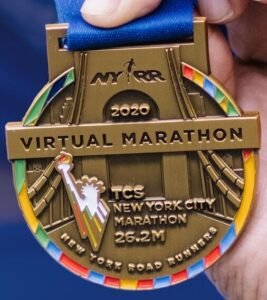
A beautiful addition to the collection that I should be getting soon. This will commemorate my 10th Marathon

Sixty dollars was an affordable price, and a spectacular medal a welcomed incentive. Not sure what else is included, but it is irrelevant. You had between October 17 and November 1 to complete the 26.2. This was just between 8 and 10 weeks away depending on the date I ran it. I settled for October 24th so I could have an extra week of training and a spare one should anything go wrong.

Because of an injury some and health issues I went through last year, I hadn’t run more than 10 kilometers straight during the year. I had gone longer when including walking breaks. Run/walk intervals allowed me to get my fitness and aerobic capacity back. I also had to shed a few extra pounds. So I prepared a NYC plan focusing on steady increment of mileage, management of effort and heart rate control based on full recovery. Finishing time for this one was a secondary consideration. Finishing strong and without injury was more than enough reward.

My plan called for a few running miles at the start and from there on, run half mile and walk another half. Yes, a lot of walking, but I didn’t want to get my heart rate so high that that it would become unsustainable and force me to walk the last 10 miles. As I trained and was able to run more miles, I felt the recovery periods were way too long, so I adjusted. My longest training session was 17 miles, my longest non-stop run was 9 miles. My run/walk intervals got set to .6/.4. I was ready to go.

Virtual Marathon

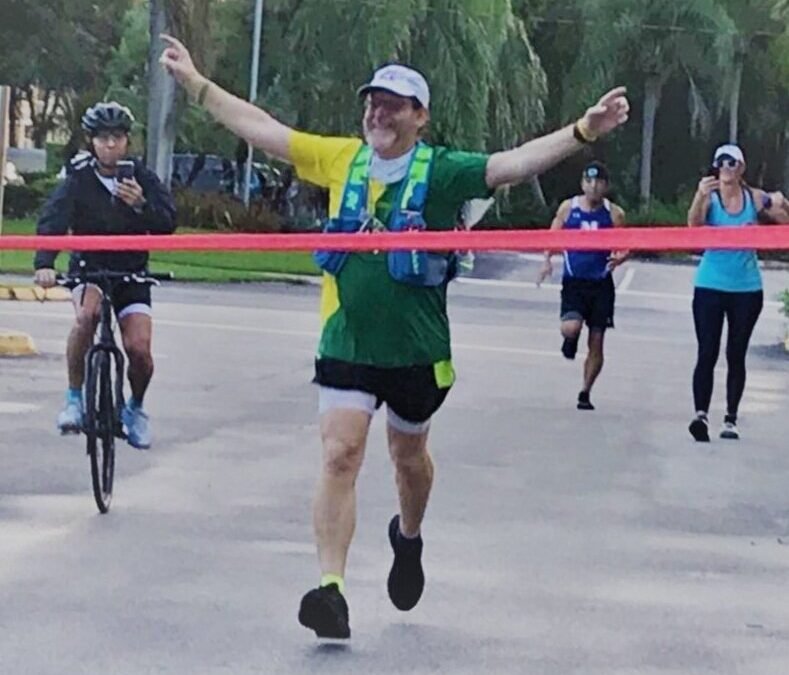
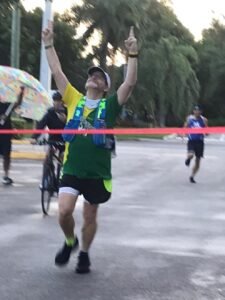
Thanking God as I cross the finish line, surrounded by my running family.

Then, October 24th, 2020 arrived and at 2:26AM I hit the road. I ran the first 6 miles and met with Bill and Rita about 3:30 am for my first water and resupply stop. From there on, I started my run/walk protocol. At first it bothered me to walk when I still felt strong, but I knew it was an investment towards the last miles, and it paid off. At mile 10, I met up with Ted, who accompanied me the next 8 miles. Up to this point my wife followed me in the car, so slow that a cop found it suspicious enough to stop her.

Close to Mile 17, the most amazing thing happened. A caravan of my running buddies passed by with horns, cowbells, yelling and screaming. A shot of adrenaline invaded my body. They were going to our regular Saturday starting spot, where I met them to pick up my last supply cache from Patrick. Once there, I kept going for my last 8.2 miles with a few friends here and there. Ruben stuck with me and ran/walked with me the whole way, sacrificing his training for the day.

I may have missed then entrance to First Avenue from the Queensboro Bridge, but what my buddies from the No-Club Runners had at the finish line was equally impressive. I choked as I ran towards the line through a tunnel of screaming, yelling, cowbells, paparazzi and the support of those who were genuinely elated to share this moment with me. It was not Central Park, but I wouldn’t trade this finish line for it.

Final time accepted by NYRRC was 5:28:14. Almost two minutes below my wildest expectations.

Virtual Marathon

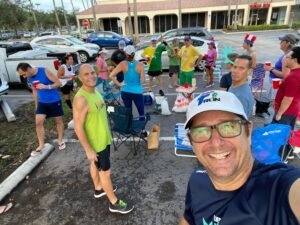
Post-marathon celebration with my buddies from the No-Club Runners. What an amazing bunch of people.

I have been asked if I count this experience as a completed marathon. If I count it as my 3rd time completing NYC? The answer to both questions is yes. The answers are affirmative because this was an established and scheduled race. It did not happen this year because of Covid. This is not a race that popped up to sell you a medal taking advantage of the pandemic. There was a strict time frame on when to do complete the specific distance. This was not a “run what you want, when you want” scheme. On a personal level, it is not like I’ve ran 26.2 so often that I lost count. This is just my 10th time at the distance.

This experience taught me is that I am mentally stronger than I thought. That if I am smart about how to approach certain challenges, adjusting as I work towards them, I can achieve and complete them successfully and safely. That the marathon is still a great adversary, but no unconquerable. And, above all, that I have a running family for which superlative adjectives to qualify them would make no justice to what they mean to me.

Running with a Mask in Times of Pandemic

Running with a Mask in Times of Pandemic

By Coach Adolfo Salgueiro

Before we get started, I must remind everyone that I am not an infectious medicine specialist. If you want scientific advice, I recommend you listen and follow what Dr. Anthony Fauci has to say regarding Covid-19. With this disclaimer out of the way, the following are my thoughts on running with a mask during times of pandemic.

Running with a Mask

By trial-and-error we will find what works best of us individually (Photo by cottonbro from Pexels)

Eight months or so into the Covid-19 pandemic, and four after the economy was inevitably reopened, we’ve returned to our group activities such as work, extended family and exercising with as much caution as possible. Social distancing keeps being the new norm, hugs and kisses have been replaced to fist and elbow bumps, and masks have become a political issue. As runners, we’ve had to adjust to this new reality in order to keep moving forward and to keep the social aspect of our sport alive. The uncomfortableness of wearing a mask is a small price to pay.

According to Certified Personal Trainer Timothy Lyman in a recent article in Runner’s World Magazine,  “Running with a mask, or any other type of face covering, is inherently more difficult because you have to work harder to get the same amount of air into your lungs”. Of course this will vary depending on the type of are wearing.

Getting used to running covering your nose and mouth requires time, commitment and training. Figuring out what mask works better for you, when is the best time to have it on or just available for immediate use, are part of such training. Knowing in what situations you should or should not wear it has also been a trial-and-error endeavor.

The same article in Runner’s World states that: As a general rule, a mask is necessary if you’re running in a populated area where you’re likely to encounter other people. If you’re running alone in an area where you won’t encounter others or come within 6 feet (at a minimum) of others, it’s likely not necessary. But keep in mind that wearing a face covering is not a substitute for physical distancing—make sure to still keep at least six feet of distance between yourself and others while running.

Through my personal experience running over 600 miles during the pandemic, what I’ve figure out is that even though I may not need a mask when I run alone, I rather have one because inevitably I will cross paths with strangers that either do not care to help you create the safe distance or, you meet them in places where it is just impossible to separate. Therefore, I always run with a cloth mask on my chin or neck, which I can immediately access to cover my face when required. It has worked so far for me and I recommend it.

Running with a Mask

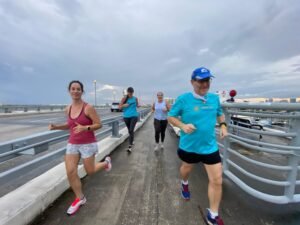
It is important to keep your social distance even if you are running with your buddies (check how I have a mask on my neck ready to be used at a moment’s notice) – Photo by Ted Sassi.

In my two running groups, we all use face coverings until we start. As for running together, we try to stay close enough to keep the social aspect of running alive but separate enough to adhere to the protocols. The post-run cafĂŠ-con-leche or beers, are strictly held outdoors.

For group running, Dr. Jennifer Marin, from @Obesalud, recommends not running one behind the next but keeping a diagonal formation with 5-meter (15 feet) of separation. This is an interesting, overcautious suggestion, worth looking into.

An important consideration is that, regardless of the type of mask you wear, you need to go out of your way to keep it clean and disinfected. The constant breathing will dampen it and thus less effective. I you don’t wash it; it will attract microorganisms that you will be breathing in and may negate the benefits of wearing a mask in the first place. So make sure you keep several of them in your running bag so you can rotate them appropriately.

Yes, running with a mask is a pain in the ass. No questions about it. But a worse option is having Covid-19. So suck it up, get used to the discomfort, wear a mask like a good citizen and keep on running with your buddies.

The Medal Collection is Finally Complete

The Medal Collection is Finally Complete

By Coach Adolfo Salgueiro

 In today’s blogpost I am going to go personal, as something super cool just happened to me a couple of weeks ago. So cool, that I am still trying to figure out if it actually happened. Well, I wouldn’t go that far, but amazing, nevertheless.

As many of my friends know, as well as readers who have taken the time to read My Running Story page in my website, I started running when I was very young. At 17 I ran my very first marathon. That race was an amazing experience that, almost four decades later, I still cherish and one of the coolest ones from my teenage years. There are not many high schoolers with a full marathon under their soles.

Medal Collection

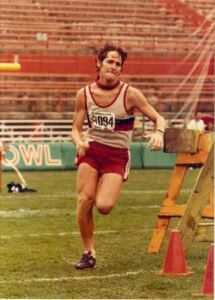
At 17, a senior in high school, and just a few yards away of finishing my very first full marathon

On January 22nd, 1983, my dad and I lined up at the foot of the old Orange Bowl Stadium for a 7AM start of the Orange Bowl Marathon. I remember a humid and rainy day in Miami and Bill Rodgers as the favorite to win. Our plan was to run the first 35K (about 22 miles) together and then every man was on his own. We cross paths with Rodgers twice during in-an-outs at Coral Way and Coconut Grove. Then, at mile 22 my dad left me in the dust and finished in 3:55. After walking a few painful and humbling miles, I triumphally crossed the finish line in 4:11:11. What a thrill to fall on my dad’s arms a few feet after and ask him: “When do we do this again”. But I digress.

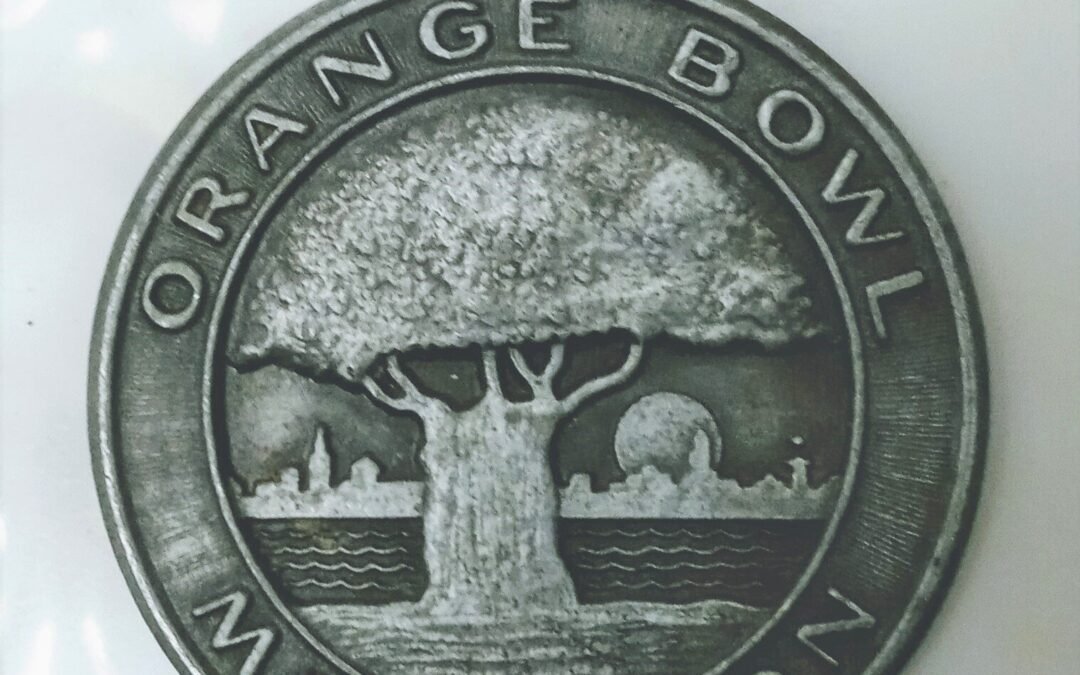
The point of this story is that back in 1983, getting a medal worth its place in an art gallery was not the norm. New York was famous for handing medals to every finisher. My dad had one from the previous year. The Orange Bowl offered medals to the first 500 or 1000 finishers, I don’t recall precisely. What I do recall is that I did not get one. I have finished eight more marathons and despite some beautiful medals to represent my achievements, there was always a hole in my collection. A hole that may never be filled.

Until now.

On September 2, I was at my computer and for some reason the thought of the 1983 Orange Bowl Marathon and my lack of medal, crossed my mind. So I did a Google search and, to my most absolute astonishing surprise, there was one for sale in eBay for $15.99 plus $2 for shipping. I could not believe my eyes. The elusive medal was somewhere out there. I have never even seen one. But from my race shirt I recognized the logo and that was it. Just a few clicks away. Calling my name. Winking at me. I could not let the opportunity go. I purchased it right away.

The times I thought about the missing piece in my collection, I entertained finding a nice shell in the beach, hang it in a string, and call it my Orange Bowl 1983 memento. But it never went beyond a passing thought. The absence in the collection persisted.

On September 9, 2020, 37 years, 7 months, and 18 days after I crossed the line of my first marathon, the package arrived. I finally had the medal in my hands. A plain, cheap, worn out piece of metal. Maybe an inch and a half in diameter and not even attached to a string or lace. Not the prettiest puppy in the litter, but MY medal. The representation of MY achievement on that day, from when I was still a senior in high school.

This medal doesn’t fill a hole in my soul, just a hole in my medal collection. With nine marathon finishes I have done better times, travel to other states and countries, ran in some of the biggest races in the world, and accumulated countless stories. How I got my medal 13,746 days later, has just been added to the memories.

So, Tell Me About Your VO2Max

So, Tell Me About Your VO2Max

By Coach Adolfo Salgueiro

It is interesting when you with your running buddies and they start bragging about their VO2Max number. “Mine is 41”, says Runner #1. “Mine is currently at 39 but it has been going up for the last 3 weeks”, comes back Runner #2. “I am down to 43 but have been up to 44 as recently as last month”, chimes in the Runner #3. Funny thing is that if you ask any of them what VO2Max is, you can pretty much bet that none of them will know.

VO2Max

These are the elements that conform VO2Max (British spelling used here)

VO2Max stands for the maximum (Max) volume (V) of oxygen (O2) that your body can utilize at maximum effort. It is obvious that the more oxygen your body can handle, the more efficient it is and the faster you should be able to run. Eliud Kipchoge has been measured at 75 while the fittest of my readers most likely be under 50.

VO2Max is measured as an absolute rate in liters of oxygen per minute (L/min) or as a relative rate in in milliliters of oxygen per kilo of body mass per minute (ml/kg/min). Yes, this is a little bit technical, well, more than a little bit. The point here is to understand that if you can barely grasp the concept and how this parameter is measured, you shouldn’t make it your end-all factor to measure your progress, let alone your value as a runner.

The VO2Max is a valuable tool if you know what you are looking at. But lately it has become overemphasized, primarily because watches now flash the number as if it were a badge of honor.

VO2Max

Unless your watch can be hooked to this machine, it cannot measure your VO2Max

VO2Max is tested in a specialized lab. While on a treadmill, with a mask covering your nose and mouth, while running to exhaustion, the machinery measures how much oxygen goes into your body and how much oxygen comes out. The difference between the two numbers while at maximum effort, is the maximum amount of oxygen your body can process at such speed, thus, your VO2Max. Your watch cannot measure this, regardless of how sophisticated and expensive it is.

In conclusion, VO2Max may work or not, I am not a sports scientist nor have read enough to know the extent of its reach. But what I do know is that it is not the end-all parameter to measure your progress or success. To me, a PR on my next 5K or marathon seems a much better way. And, once again, it CANNOT be measure by an equation on your watch.

It is not in the scope of this blogpost to advocate for or against VO2Max. It is not either to explain the science and value of the parameter, which, of course, does have a value.

If you want to learns more about the subject and are ready for a deep technical read, Steve Magness, head coach for the University of Houston, and an authority on the science of running, has a few articles on this, which I highly recommend. You can click on the links below to access them:

The Trap of Information Overload

The Trap of Information Overload

By Coach Adolfo Salgueiro

Information Overload

GPS watches are great, but not all the info is needed right away

Let’s start by stating that I see nothing wrong with being on Strava, having an Instagram account to share your runs or checking Facebook every so often to see what your running buddies are up to. It is great to live in a time when, via social media, we can still be in contact with people we haven’t seen in 30 years, or keeping in touch with that cousin that moved to another country and you rarely have the chance to see anymore.

It is great to being able to make social media acquaintances even though you never met them in person. In my case, I follow a Dutch marathoner named @mistermarathon on Instagram and he followed me back. When I visited Amsterdam, he took me for a running tour of the city, we had coffee and had a great talk. A few years later he visited Florida and even though I was injured and couldn’t run, we met for coffee and had another great conversation. That is awesome.

Now, there must be a limit. The data overload from social media, from our watches, from WhatsApp groups and from measuring up with strangers, is stealing the joy from a considerable portion of the running universe. And the main reason we run is because we like it. So, if something is stealing our joy, it must go or, at least, its presence must be adjusted.

Yes, a pre-run picture with your buddies is cool, but if you missed it, you can still run. Forgetting to charge your watch is not an excuse to skip a scheduled training. Checking your favorite elite runner on Strava and trying to match their trainings is a recipe for injury. Thinking that an ultrarunner in Germany or Australia or Argentina is your buddy because he likes your posts on a regular basis is the prelude for a letdown. Wanting to run from New York to Los Angeles because so-and-so did it, is insane.

It starts with regulating the consumption of information we get from our GPS watches. It is wonderful to have all the information you can possibly want at the flip of your wrist. But, with certain exceptions dictated by a specific segment of your training program, the usefulness of such information is relatively innocuous. It is just a reflection of what you are doing, not what you are doing and definitely not your worth as an athlete. You don’t have to pause the watch because you are at a red light or because you stopped 10 seconds to say hi to another runner. You don’t have to check your cadence every mile unless you are specifically working on it. And don’t get me started on VO2Max, that’s for another post. I think you get the point.

I am amazed by the data the website I synch my watch to, can provide. Most of it is great for analysis of my training, progress and to keep historical data. The more I use Strava, the more my mind gets blown away on what it can do, but I don’t follow people I don’t know. I only follow runners I train, so I can see what they are doing, this way, I can coach them better. If I want to know what a friend is doing, I call him or text him. I don’t need to know what Eliud Kipchoge is doing every day and compare him to my progress. I don’t need kudos on my run from 50 runners I don’t know.

Information OverloadTheodore Roosevelt, the 26th President of the United States, once said that “comparison is the thief of joy”, and I agree 100% with him. Of course, we can’t avoid it all the time, it is part of our human nature. But if we want to get joy out of OUR running, we need to concentrate in what WE are doing and what WE can control. We need to center OUR running life, in OUR progress, OUR failures, OUR injuries, OUR parameters.

Most of the data is useless at the time we are running. It is afterwards that we can learn something from it and adjust. If you list the top-10 reasons why you run, I doubt that “to show up my Mary in Strava” or “to have more Instagram followers than Jimmy”, or “to improve my likes on Facebook” makes the list. Let’s go back to basics. Take advantage of the tools that technology provides but don’t be a slave to them.  

“We Have a Decision to Make”. A Reflection From Jason Fitzgerald’s Podcast.

“We Have a Decision to Make”. A Reflection From Jason Fitzgerald’s Podcast.

By Coach Adolfo Salgueiro

ReflectionI just started listening to “Strength Running” a couple of weeks ago. This is a podcast hosted by Jason Fitzgerald that, so far, I feel I can openly recommend it to my readers and trainees.

I am writing this quick blog entry because I just heard episode 138 of the series and it blew my mind. It is a quick, 6-minute reflection from the host on his view of running through the Covid-19 pandemic. It is well thought, well-written and well delivered. I was listening to it during a brisk walk and it stopped me on my tracks. I looked for a transcript in the podcast’s website but was unable to find it, so I am sharing the audio with all of you.

I invite you invest six minutes of your life listening to Mr. Fitzgerald’s reflection. It is less than the time in which most of us can run a mile, and most likely you will get something out of it. The audio file is at the bottom of this post.

I hope Mr. Fitzgerald doesn’t mind my sharing his point of view. If you want more information on his podcast, you can click here to visit his website.

 
Skip to content